Resume / CV
Chief Information Officer | Enterprise Technology & Platform Executive | AI Strategy Leader
PROFESSIONAL SUMMARY
I am a technology executive who went deep in every major discipline — software engineering, infrastructure, enterprise architecture, clinical applications, security, and AI — and used that compounding depth to build products, launch a business, and run technology for organizations that couldn't afford to get it wrong. I co-founded Optum Connect, designing the cloud reference architecture and managed services products that grew a five-person team into a 600-person operation serving six healthcare systems — and served as virtual CIO and virtual CISO across all of them. Most CIOs came up through one lane. I came up through all of them, which means I don't just manage the technology organization — I read the entire board and spot where a breakdown in one area creates a cascade in three others. I now bring that depth to enterprises navigating AI adoption, cloud modernization, and the organizational transformation required to make both real.
STRATEGIC DIFFERENTIATORS
- Enterprise Technology Strategy & Platform Modernization: Architect enterprise-wide technology roadmaps — transforming legacy environments into scalable, AI-ready cloud platforms aligned with business growth, regulatory requirements, and long-term operational resilience.
- Technology Product Development: Design and launch technology products the business takes to market — Cloud-as-a-Service, SOC-as-a-Service — creating new revenue streams and proving that technology leadership is a growth engine, not a cost center.
- Full-Stack Technical Depth with Executive Presence: Operate across the entire technology landscape — software, infrastructure, architecture, clinical applications, security, and AI — with the engineering depth to find root causes others miss and the executive fluency to translate them into decisions boards can act on.
- Security & Risk as Architectural Fluency: Bring native security and risk depth to every technology decision — not as a compliance overlay, but as embedded architectural thinking that eliminates the translation gap between CIO and CISO and accelerates board-level risk conversations.
PROFESSIONAL EXPERIENCE
Mufasa Technology Group — 04/2026 – Present
Principal Consultant & Fractional CIO
Independent technology advisory practice providing executive-level consulting across enterprise technology strategy, cybersecurity program architecture, and regulatory readiness.
- Fractional CIO Advisory: Serving as fractional CIO for a national research and hospital environment — advising executive leadership on technology strategy, organizational design, and operational alignment across clinical and research missions.
- CMMC Level 2 Readiness & Certification: Led a CMMC Level 2 readiness assessment and remediation for a defense industrial base manufacturer — delivering the full engagement in half the contracted timeline and successfully achieving certification on the first C3PAO assessment.
INTEGRIS Health — 04/2024 - 03/2026
Chief Architect — Enterprise Technology & Security (Deputy CIO / Deputy CISO Scope)
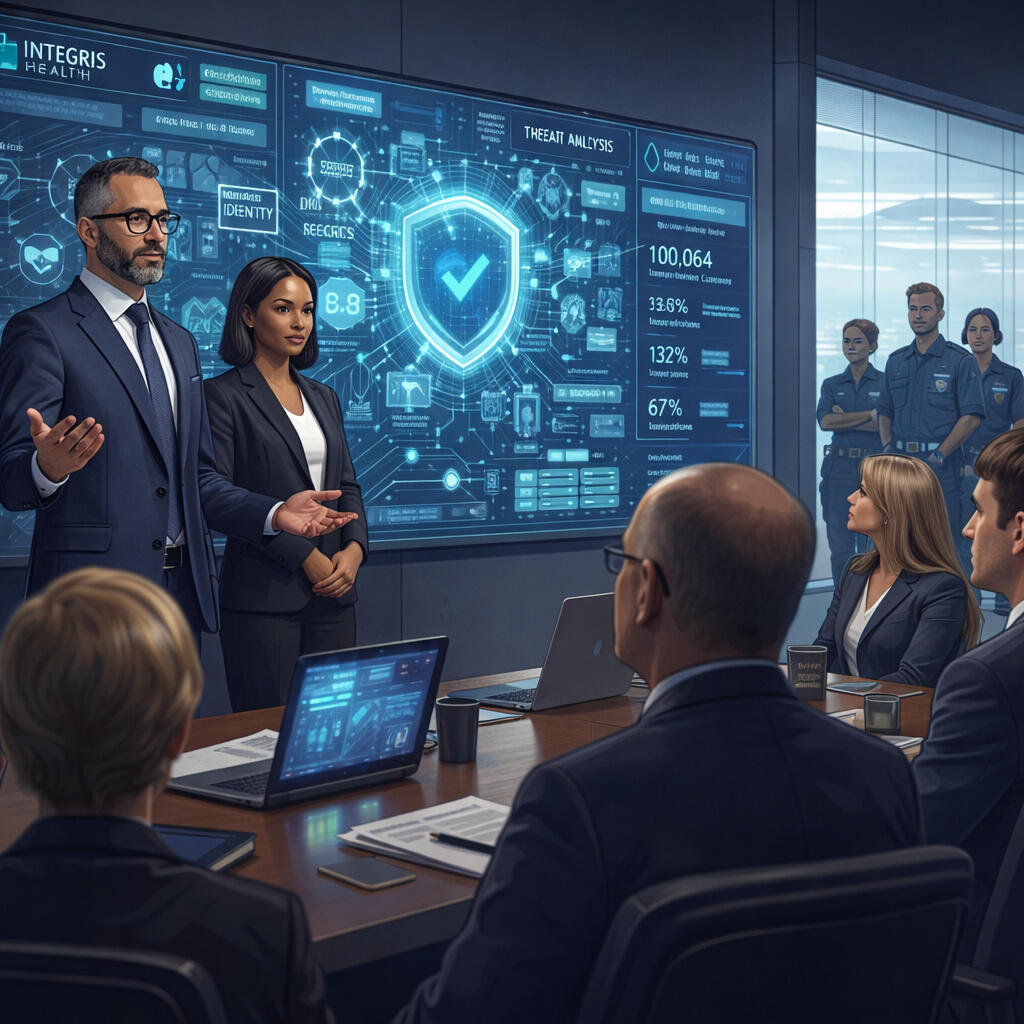
Recruited by two former Optum colleagues — the CISO and CTO — into Oklahoma's largest healthcare system ($3.3B revenue, 15K caregivers, 20 hospitals, 184 clinics) to rebuild a security program and partner with IT leadership to insource technology and security operations that had been heavily outsourced. My scope extended beyond security from day one — I partnered with the CTO to recruit three director-level leaders across a 110-person technology organization and developed a three-year enterprise architecture roadmap spanning cloud adoption, Zero Trust migration, RBAC redesign, and network segmentation. I then led a 24-month security and platform transformation that restored board confidence and earned industry recognition within the first year.
- Technology Budget & Investment Stewardship: Managed a $60M technology and operations budget, driving prioritization and investment alignment backed by automated Power BI dashboards delivering real-time board-level visibility across risk posture, project intake, KPIs, and high-risk approvals.
- Organizational Transformation & Insourcing: Restructured a 38-person security organization into engineering, operations, and service delivery divisions — replacing outsourced dependency with internal capability, increasing project throughput 135%, and reducing MTTR 65%.
- Identity Modernization & Root Cause Discovery: Took over a twice-failed identity governance deployment, traced the root cause upstream to a system migration that moved data without restructuring it — leaving HR teams making access decisions from memory. Translated the finding to executive leadership as a structural integration flaw, unlocking progress stalled for over a year.
- Enterprise AI Strategy & Adoption: Led the organization's AI readiness strategy — securing M365 and Azure data foundations, standing up an AI Governance Council, building the first AI governance framework, and leading enterprise deployment of Microsoft 365 Copilot in a regulated healthcare environment.
- Post-Breach Recovery & Program Maturity: Rebuilt GRC into an enterprise-wide governance program, cleared 100K+ CVEs in seven months, evolved the SOC into a Cyber Fusion Center, and drove enterprise-wide BCP renewal to full coverage within a single year.
- Recognition: Named DC100 Top 100 Deputy CISO (2025); program recognized by Becker's Hospital Review '53 CISOs & CPOs to Know' (2025).
Optum — 01/2015 –04/2024
Chief Architect & Director of IT, Cloud, and Security | Co-Founder, Optum Connect
An executive on Optum's commercial side needed to sell managed services to small and mid-sized healthcare providers. When he went to IT leadership, the answer was millions of dollars in VMware infrastructure — costs those providers were never going to absorb. That executive found his way to me. I saw a different path: by architecting on Azure and becoming a Microsoft Cloud Service Provider, Optum could resell and manage client cloud environments without owning them — no upfront investment, no new balance sheet exposure. I designed the reference architecture, the executive took it to a client, the client signed, and that single contract launched Optum Connect. I then took ownership of the platform and helped scale it from a five-person founding team into a 600-person managed services operation — the platform and products I designed underpinning multi-billion-dollar, decade-long contracts across six healthcare systems — serving as virtual CIO and virtual CISO across all of them.
Clients Transformed: Triple-S of Puerto Rico, John Muir Health, Bassett Health, Northern Light Health, Owensboro Health, and Allina Health.
- Managed Services Product Development: Designed and launched the products the business took to market — Fully Managed Cloud-as-a-Service and SOC-as-a-Service — the revenue engine behind multi-billion-dollar managed services contracts spanning a decade across six healthcare systems.
- Cloud Platform Architecture: Conceived and led the policy-driven cloud guardrail system powering Cloud-as-a-Service on Azure and AWS — delivering self-service environment provisioning in hours rather than months, with security and compliance enforced by default through CI/CD automation, policy-as-code, and integrated SAST/DAST testing.
- Executive Technology Partnership (vCIO & vCISO): Served as virtual CIO and virtual CISO across six healthcare systems, advising client executives on technology investment sequencing, roadmap alignment, and service reliability — translating complex tradeoffs into clear business decisions.
- Epic-on-Azure Architecture: Served as the cross-vendor bridge between Epic and Microsoft Azure, refining early cloud design patterns for one of healthcare's most sensitive clinical platforms — contributing to approaches later reflected in Microsoft's formalized guidance for enterprise healthcare deployments.
- Platform Innovation Legacy: The cloud guardrail platform became the catalyst for Optum's broader enterprise cloud transformation, driving adoption of automation-first, as-code architectures across the organization.
- Talent & Culture: Built high-performing teams by prioritizing psychological safety, clear decision rights, and a coaching culture — developing leaders who carried standards and outcomes forward through sustained organizational change.
Target — 09/2012 –01/2015
Platform Engineering & Architecture Lead
Led engineering and operations for 22 enterprise technology and security platforms at one of the world's largest retailers, scaling the team from 8 to 25 engineers in under a year. When a critical SSL certificate management tool was denied due to cost, I architected an in-house certificate lifecycle management platform and led my team through development — building automated notification, escalation, and auto-provisioning capabilities, then drove a year-long cross-functional campaign educating application owners across the enterprise on certificate lifecycle management. I architected and deployed Target's first privileged access management system, overhauled the incident command and root cause analysis program, and drove automation initiatives that delivered $700K+ in documented savings. Contributed to breach remediation efforts during the 2013 Target breach — one of the most significant retail security incidents in industry history.
Boston Scientific — 05/2007 – 09/2012
Production Platform Engineer & Architect
Hired as a software developer on the LATITUDE program — a medical device-classified global patient monitoring system connecting pacemakers to a physician portal, with data centers in the United States and Ireland. Because FDA classification required a year-long release cycle, I developed creative software solutions to maintain patient-care operations between releases. As trust grew, my scope expanded from software into middleware integration, infrastructure — leading a major storage array upgrade — and architecture, where I was selected to architect the next-generation LATITUDE NXT platform. Owned the BCDR plan and served as tabletop director, leading the entire program through annual weekend-long disaster recovery exercises.
EARLY CAREER ROLES
Evolve Systems — Software Engineer (2005–2007): Built custom e-commerce and database-driven web applications for small business clients on the LAMP stack, including payment gateway integrations and secure transaction workflows.
Murphy McGinnis Internet / Superior Broadband — Operations Manager & Software Engineer (2001–2005): Began in technical support and advanced into service operations leadership and LAMP stack development, building custom applications and Linux infrastructure supporting rural broadband delivery across northern Minnesota.
APPLIED AI
Project:Wells — (2025-2026) AI Knowledge Architecture & Validation: Built a custom AI system grounded in a structured knowledge base capturing how I think, lead, and make decisions. Validated it against real-world decisions I had already made independently — it reached the same conclusions. The principle applies at enterprise scale: AI is only as good as the knowledge architecture behind it.
AWARDS
EDUCATION
Technological Leadership Institute, University of Minnesota - Twin Cities
Master of Science, Security Technologies
The Master of Science in Security Technologies (MSST) shapes tomorrow’s analytical and risk management policymakers and innovators through a multi-disciplinary graduate program developed in response to growing demand in many levels of industry and government. The program draws on the fields of systems risk analysis, engineering (hardware and software), emerging technologies, economics, human factors, law, food and bio safety, and public policy to teach and investigate security technologies and address pertinent issues.
University of Wisconsin - Superior
Bachelor of Science, Computer Science + Mathematics Concentration